
Everyone Has a Hidden Superpower
Making Sense of Yourself (Without Losing Your Cool)

When I retired from the military, I thought I was too smart to have a classic post-career identity crisis. It turns out I was too dumb to realize it was happening.
The road to rediscovery and reintegration was surprising. It had more to do with tapping into things I sucked at than leveraging existing skills.
I’ll begin at the end, which wasn’t the end but the moment something started to click, something new.
Discovering My Inferior Function — in a Kitchen
My “superior” functions are thinking and intuition. I live in my head: diagrams, strategy, problem-solving, philosophical rabbit holes. I read rooms and intuit vibes, what I’d call in military jargon “atmospherics.” My weak link? Sensing. I’m the guy who forgets his keys and phone while explaining to glazed eyes what order and chaos mean in the Yin & Yang symbol.
Then life threw me a curveball. After a full military career, I ended up running the operations for a handful of restaurants. Suddenly, I wasn’t just managing schedules and spreadsheets; I was chasing down busted refrigeration units, clogged drains, and mystery noises in the ductwork. I went from being the idea guy to the one with a wrench in his hand, standing ankle-deep in sudsy water at midnight. I was shocked to discover that I liked it.
At first, it was chaos. But here’s the thing: once I started using that neglected “sensing” muscle, it lit something up. Fixing stuff, no matter how improvised (“hillbilly engineering,” as my crew affectionately called it), gave a grounded satisfaction my usual cerebral work never did. It wasn’t about perfection; it was functional flow. If it worked and got us through another Friday dinner rush, that was a win.
What Makes People Tick
Many of us might like to better know what makes people tick — especially ourselves. But trying to decode human behavior can feel like decoding hieroglyphics.
Samuel Barondes’ Making Sense of People is one of those books that makes psych jargon sound like something you could actually use without a lab coat. Think of it like a street map for the mind. It’s not GPS-level precise, but it’s enough to keep you from driving in circles.
Barondes starts with the Big Five personality traits, also known as OCEAN: Openness, Conscientiousness, Extraversion, Agreeableness, and Neuroticism. They’re each basically the individual theme songs for how people show up in life. Are you curious or closed off? Reliable or messy? Chill or wound tighter than a catapult cable? Everyone lands somewhere on each scale. There’s no single label that fits, because most of us are a homemade mixtape.
Psychologists Paul Costa and Robert McCrae at the NIH took this idea and built the NEO-PI-R test, which breaks each of those traits into six smaller traits. That way, you don’t just get “extrovert” as a label; you get the story behind it. When you start noticing these traits in yourself (and, inevitably, in everyone else), the whole people-watching game changes. It’s no longer “why are they like that?” and more like “ah, I feel the beat they’re bumping to.” Tapping into your own or someone else’s rhythm simplifies interactions: you know better what to expect and can more accurately decipher reactions.
Barondes also dives into personality disorders, which are basically what happens when one of those traits turns the volume up to eleven and won’t fade back down. You’ve likely heard the labels before: antisocial, narcissistic, avoidant, compulsive, histrionic, and so on. Each is marked by its own flavor of distress or disruption in relationships.
If none of them ring a bell, maybe you’re just not ready to look in the mirror yet.
But the point of Barondes’ work isn’t labeling people as broken. It shows how understanding personality, biology, and habits can help us make smarter choices. It’s like reading a book about dancing: knowledge only matters when it turns into moves.
The Four Functions: A Different Kind of Map
If the Big Five are your horizontal map, like a city grid, Jungian psychology adds the vertical layers, like the subway tunnels beneath or the basements and attics in a big house. Jung saw four main “functions” in how we experience the world: Thinking, Feeling, Intuition, and Sensing. Thinking runs the logic; Feeling handles the vibe, energy, and atmospherics. Intuition sees patterns and connects dots; Sensing keeps us grounded in the here and now: taste, touch, smell, sound, sight, all the material that thinkers like to forget about.
Most of us get really good at one or two functions early on, and maybe recruit a third along the way for support. The problem is that our weakest function, the one we keep shoving to the back for decades, eventually starts banging on the door. That’s your “inferior function,” and it won’t be ignored forever. Reclaiming and integrating this function leads to the psychologist’s version of transformation. “Transformation” is most often reclamation. The natural state of the untended man is ruin. We allow ourselves, through 1,000s of indignities, to be formed by the world into something often both unrecognizable and detestable, a construct built for survival.
The inferior function provides clues to our elemental identity, who we were before “life”, and who, from the depths of our neglected shadow, we can salvage and reclaim. It is our truest self, the one God put on this earth to fight the demon hordes at Armageddon, the one who laughs at the khakied “yes man”, the hypocritical church member, the pandering husband, and the habit-slave decomposing on his couch.
We CAN reclaim what we are designed to be.
It starts by saying “no”, or lifting something heavy, or simply walking out and not looking back. No man who puts his hand to the plow, but who looks back, is fit for the Kingdom.
When you hit midlife and start side-eyeing convertibles or dressing like a teenager, that’s often your buried function trying to grab the mic. The long-ignored part of you suddenly wants a cameo, at the very least, but it sometimes throws elbows for lead vocals and launches equipment off the stage. It has a lifetime of unused power, and it can wreak havoc. Understanding this can reduce a midlife crisis from a fiery crash to a fender-bender.
The Inferior Function and the Unlived Life
Robert Johnson, writing about Jung, called that neglected part “the unlived life.” It’s all the stuff we pushed aside: feelings we stuffed down, dreams we ghosted, talents we convinced ourselves we didn’t need. One day, they come back: louder, rawer, sometimes messy as hell.
If you’re a thinker, your feelings might ambush you at 3 AM. If you live in the body, your intuition might start throwing cheap kidney punches. Whatever side you’ve ignored will eventually demand stage time. Jung even thought that our deepest sense of meaning, the mystical stuff, lives in that neglected zone, which he called the shadow.
The sacred doesn’t sit in the polished, rehearsed parts of us; it hides in the unfiltered freestyle sessions.
So what do you do? You don’t fight it; you invite it. Give it space: a sitting room or a side venue where it can show up without wrecking the house. Let that weird, awkward energy become creative instead of destructive. Every time you stretch the part of yourself that feels clumsy or out of style, you’re quietly remixing your whole identity.
Exercising the Weakest Muscle
That season taught me something huge: your weak spot doesn’t have to stay weak. It’s just undertrained. Every time you practice the part of yourself that feels awkward — whether it’s expressing emotion, paying attention to detail, or trusting your instincts — you reclaim a piece of your own energy. You live less like a 2-D character and start becoming a full score instead of just the hook you’ve dropped your whole life.
Each of us has that unlived part waiting to jump back in the mix. The question is, do you keep ignoring it until it kicks in your back door, or do you invite it to your next pre-mission brief and give it a gun?
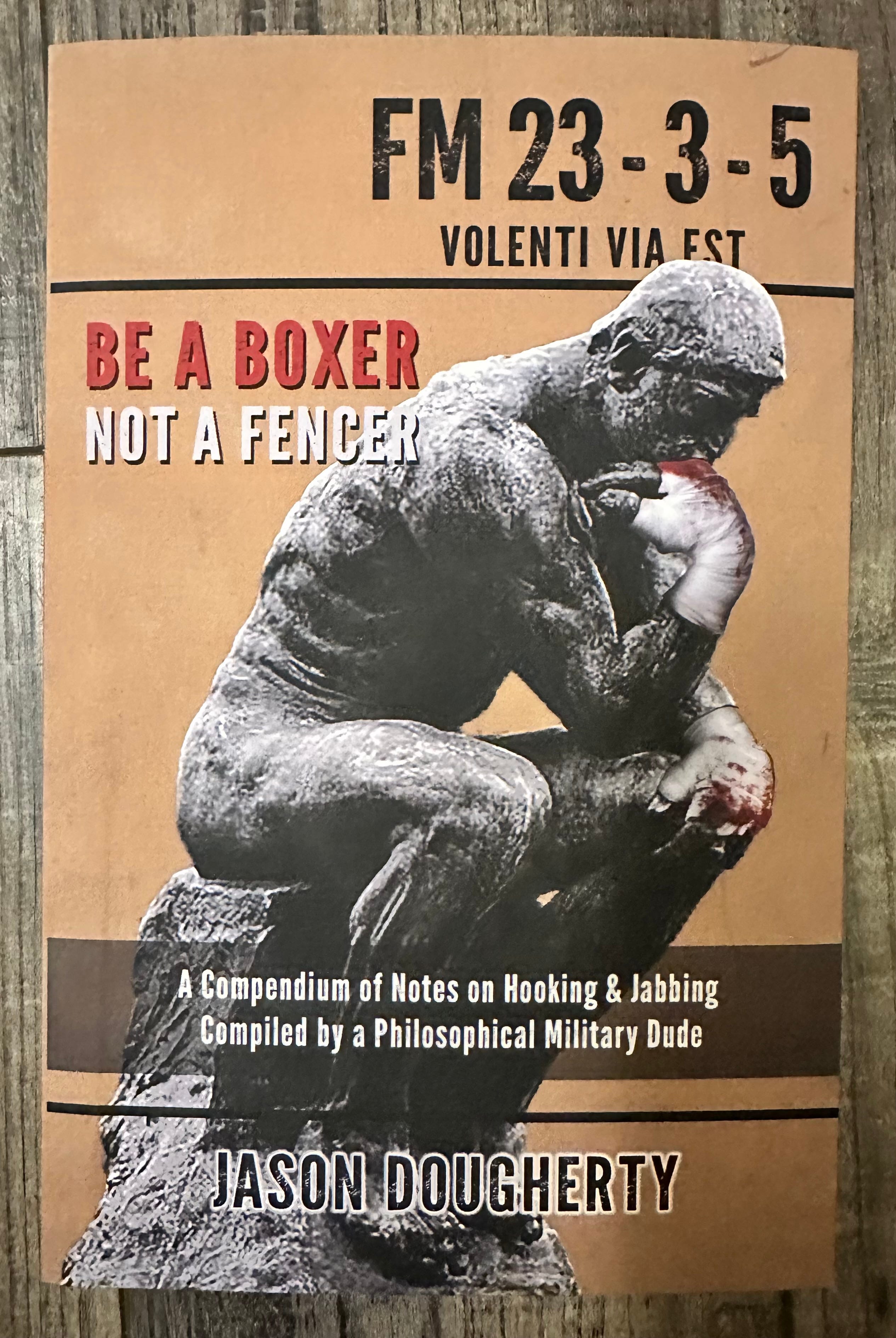
There’s much more to it than this. For a more complete treatment, buy my field manual: Be a Boxer
Very good Thanks.